



In today’s dynamic and competitive business environment, building a coaching culture is no longer optional—it’s essential. A coaching culture empowers employees, enhances leadership, and drives organisational success. By focusing on the critical success factors, organisations can create a sustainable and impactful coaching environment.
What is a Coaching Culture?
A coaching culture is an organisational environment where coaching is embedded into daily practices, fostering continuous learning, collaboration, and growth. It equips employees and leaders with the skills to navigate challenges, improve performance, and achieve personal and professional goals.
Why is a Coaching Culture Important?
Organisations with a strong coaching culture consistently outperform their peers. According to a 2019 International Coaching Federation (ICF) and the Human Capital Institute (HCI) study, 51% of organisations with a coaching culture reported revenues above their industry peers, compared to 38% of others. Coaching also enhances leadership development, employee engagement, and commitment, as evidenced by a 2023 ICF/HCI study where 73% of participants agreed on its positive impact.
Benefits of Building a Coaching Culture
For Employees and Leaders:
- Improved Leadership Effectiveness: Coaching equips leaders with the skills to inspire and guide their teams effectively.
- Enhanced Performance: Teams function better, achieving higher productivity and collaboration.
- Increased Emotional Intelligence: Employees develop self-awareness and better interpersonal skills.
- Higher Job Satisfaction: Coaching boosts confidence and job fulfilment.
For Organisations:
- Revenue Growth: Organisations with strong coaching cultures achieve higher revenues.
- Leadership Development: Coaching accelerates the growth of high-potential talent.
- Employee Engagement: A coaching culture fosters a sense of belonging and motivation among employees.
Critical Success Factors for Building a Successful Coaching Culture
To establish a robust coaching culture, organisations must focus on four critical success factors: Stakeholder Agreement, Strategic Alignment, Development, and Deployment.
1. Stakeholder Agreement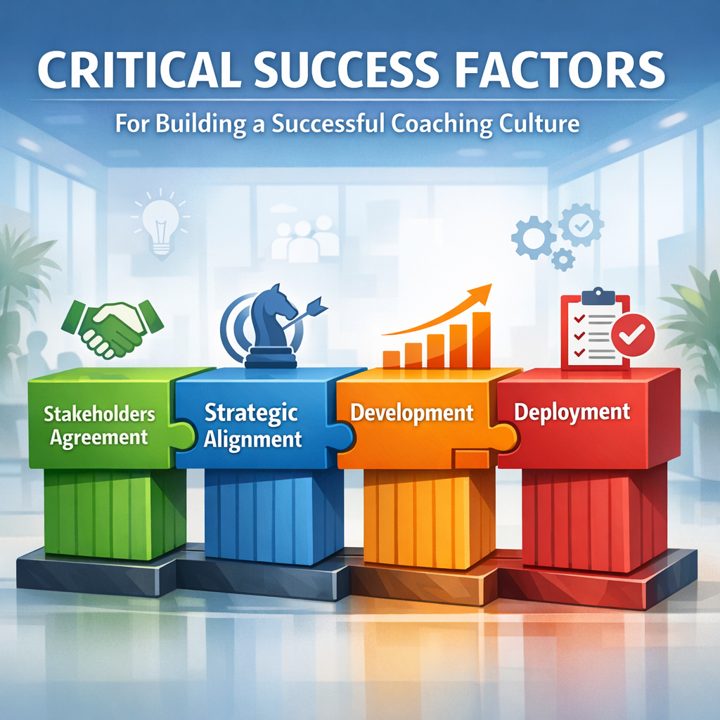
The foundation of a coaching culture lies in securing buy-in from all stakeholders. This includes:
- Top Management Support: Leaders must actively champion coaching initiatives and lead by example.
- Employee Value: Employees need to understand and appreciate the benefits of coaching for their personal and professional growth.
- Widespread Adoption: Coaching should be accessible to all employees, not limited to only senior leaders.
2. Strategic Alignment
Coaching initiatives must align with the organisation’s strategic goals to ensure measurable impact. Key aspects include:
- Integrate coaching into strategic priorities: Link coaching to leadership development, talent management, performance management, and other strategic programs. This ensures coaching contributes directly to the organisation’s success.
- Budget Allocation: Dedicate resources specifically for coaching. For instance, 33% of organisations allocated a dedicated coaching budget in 2023, up from 25% in 2019.
3. Development
Developing internal coaching capabilities is critical for sustainability. This involves:
- Building Competencies: Train internal coaches and leaders with coaching skills to ensure they are equipped to deliver impactful coaching.
- Professional Development: Offer ongoing training, credentialing, and mentoring opportunities to maintain high standards.
- Coaching Communities: Create a Coaching Community of Practice (CoP) where coaches can share challenges, ideas, and experiences, fostering continuous improvement.
4. Deployment
Effective deployment ensures coaching is implemented consistently and widely across the organisation. This includes:
- Modalities: Use a mix of internal coaches, leaders with coaching skills, and external coaches to address diverse needs.
- Criteria for Selection: Consider factors like cost, coaching expertise and familiarity with organisational culture when selecting coaches.
- In-the-Moment Coaching: Encourage leaders to engage in coachable moments, fostering a culture of immediate feedback, learning and growth.
Barriers to Building a Coaching Culture
Despite its benefits, organisations may face challenges when building a coaching culture. Common barriers include:
- Lack of Stakeholder Buy-In: Resistance from leadership or employees can hinder progress.
- Insufficient Budget Allocation: Without dedicated resources, coaching initiatives may fail to gain traction.
- Misunderstanding about Coaching: Confusion between coaching, mentoring, and teaching can dilute the effectiveness of coaching efforts.
- Resistance to Change: Employees may be hesitant to embrace new practices or see coaching as unnecessary.
Case Studies: Coaching in Action
EY Leadership & Team Coaching Practice
EY’s coaching initiatives have driven measurable impact:
- Newly Promoted Leaders: 96% gained clarity on their roles, and 88% felt stronger as leaders.
- High-Performing Teams: Increased revenue, leadership promotions, and a reputation as a preferred provider.
MD Anderson Cancer Center: 2024 ICF Coaching Impact Award Winner
 MD Anderson Cancer Center’s coaching initiatives showcase the transformative power of a coaching culture:
- Leadership Development: New leaders benefited significantly from onboarding coaching, with 95% reporting improved goal achievement and overall effectiveness.
- Teamwork and Collaboration: Teamwork favourability increased from 65% in 2017 to 86% in 2023, alongside a similar rise in team collaboration.
- Employee Engagement: Engagement rates grew dramatically, soaring from 61% in 2017 to 84% in 2023.
- Turnover and Promotions: Coaching reduced turnover by 48% and increased promotions by 41%, demonstrating its impact on retention and career growth.
Conclusion
Building a coaching culture is a strategic investment that delivers long-term benefits for individuals and organisations alike. By focusing on the critical success factors—stakeholder agreement, strategic alignment, development, and deployment—organisations can create a coaching culture that drives growth, engagement, and success.
However, one of the common barriers to building a coaching culture is the high cost of deploying coaching modalities, such as training internal coaches and equipping leaders with coaching skills. BP Coach Training addresses this challenge with its modular coaching courses for the leaders and its Certified Performance Leadership Coach (CPLC) program, an ICF-accredited coach certification to help develop internal certified coaches. These programs are SkillsFuture funded, hence, significantly reducing the financial burden for organisations. With these affordable and high-quality training options, organisations can overcome budget constraints and build a sustainable coaching culture.
Laurence Tan and Chong Eng Neo
BP Coach Training Pte Ltd
28 January 2026
For more information please contact us or email us at info@bpcoachtrain.com.