


In today’s fast-paced workplace, building cohesive, high-performing teams is no longer optional—it’s essential. As organisations face increasing complexity, the ability to foster trust, manage conflict, and align team behaviours with shared goals is critical for success.
Why EQ and DISC Are Game-Changers for Building Better Team Relationship
- DISC Awareness: A First-of-Its-Kind Tool
 A groundbreaking innovation in the assessment space, DISC Awareness combines DISC and Emotional Intelligence (EQ) assessment results to provide deeper insights into communication styles, behaviours, and emotional intelligence. This dual evaluation tool enables organisations to:
- Improve employee commitment.
- Enhance team-building efforts.
- Prevent and resolve conflicts more effectively in the workplace.
By integrating these two frameworks, DISC Awareness offers a comprehensive understanding of how individuals interact, manage emotions, and build relationships.
- Understanding Emotional Intelligence (EQ)
EQ is the ability to recognize, understand, and manage our emotions while also being attuned to the emotions of others. Research shows that individuals with high EQ are better at:
- Navigating workplace stress.
- Resolving conflicts effectively.
- Building meaningful relationships.
EQ assessments focus on behaviours like emotional self-awareness, empathy, and social management. These skills are crucial for fostering collaboration and trust within teams.
- The Role of DISC in Team Dynamics
DISC assessments measure behavioural styles—Dominance (D), Influence (I), Steadiness (S), and Conscientiousness (C)—and reveal the psychological needs driving these behaviours. For example:
- D-Style individuals thrive on control and progress.
- I-Style individuals seek connection and novelty.
- S-Style individuals prioritize harmony and belonging.
- C-Style individuals value precision and autonomy.
By understanding these styles, leaders can tailor their approach to meet team members’ unique needs, improving communication and collaboration.
- The Power of Integration: EQ + DISC
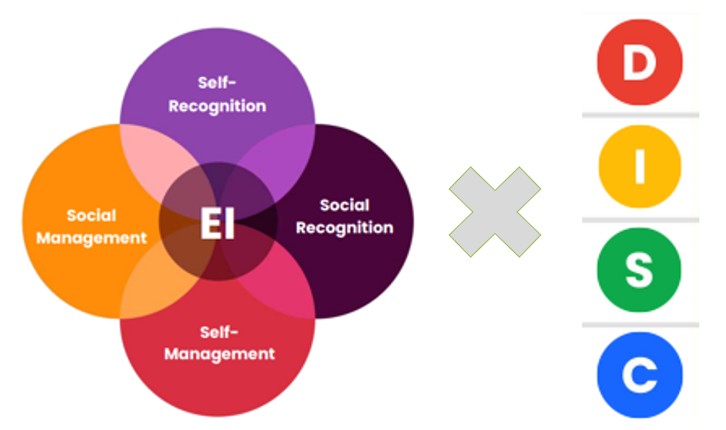 When combined, EQ and DISC provide a holistic view of individual and team behaviours, helping leaders manage conflict and improve collaboration.
Example: Managing Conflict with DISC and EQ
Consider a scenario where Alex, a D-Style individual, and Jamie, an S-Style individual, clash during a team meeting. Alex, driven by their need for progress, becomes frustrated with delays and pushes for immediate action. Jamie, valuing harmony, perceives Alex’s assertiveness as dismissive and withdraws from the discussion.
By applying EQ competencies:
- Alex uses self-awareness to recognize his frustration and adjusts his tone to invite collaboration.
- Jamie uses empathy to understand Alex’s urgency and stays engaged in the conversation.
- Both use self-management to moderate their responses, leading to a constructive dialogue.
This integration of DISC and EQ helps address the root causes of conflict—psychological needs and emotional triggers—while fostering trust and alignment within the team.
- Leveraging Lencioni’s Behavioural Framework
To provide a more structured approach to building team cohesion, Lencioni’s behavioural framework can be seamlessly integrated with DISC Awareness tools. Lencioni’s model identifies five key dysfunctions that hinder team performance:
- Absence of Trust: DISC Awareness helps uncover behavioural tendencies that may prevent trust-building.
- Fear of Conflict: EQ competencies enable teams to engage in healthy, constructive debates.
- Lack of Commitment: Understanding psychological needs through DISC fosters alignment and shared goals.
- Avoidance of Accountability: DISC and EQ provide a foundation for open, honest feedback.
- Inattention to Results: Combining EQ and DISC ensures a focus on collective outcomes rather than individual agendas.
By addressing these dysfunctions with DISC Awareness, leaders can create a cohesive, high-performing team that thrives on trust, accountability, and shared success.
How DISC and Psychological Needs Influence Emotional Intelligence
 Emotional Intelligence (EQ) is fundamentally a decision-making skill. It guides us in choosing whether to act on our emotions or take a different approach.
Through the lens of DISC, making emotionally intelligent decisions can become challenging when those decisions conflict with our psychological needs. This internal struggle is something we all experience.
If we fail to recognise and understand our deep-rooted needs, we may rationalise behaviours that don’t truly reflect who we are.
By integrating insights from both DISC and EQ, individuals can gain clarity about these internal dynamics, enabling them to make more intentional, emotionally intelligent choices.
About the Certified EQ and DISC Practitioner Course
This course is designed to empower participants with practical tools and strategies in one-on-one or team coaching settings. This will enable their clients/employees to develop greater self-awareness, build stronger relationships, take greater accountability, and enhance their performance.
Key features include:
- Comprehensive Curriculum: Learn to diagnose team dysfunctions, build trust, and design interventions to improve team dynamics.
- Blended Learning: A mix of pre-course eLearning and a two-day facilitated classroom session ensures deep understanding and application.
- Practical Tools: Gain hands-on experience with DISC Awareness (a first-of-its-kind evaluation tool that integrates DISC and Emotional Intelligence (EQ) Assessment results) to address real-world challenges.
- Expert Facilitators: Learn from seasoned coaches with decades of experience in leadership and organisational development.
Why This Course Matters
Organisations that prioritise team cohesion see measurable benefits, including:
- Increased employee commitment and cooperation.
- More effective conflict resolution.
- Enhanced overall performance.
By becoming a Certified EQ and DISC Behavioural Practitioner, you’ll be equipped to lead teams toward greater collaboration and success, making a tangible impact on your organisation.
📅 Join Us Today!
Ready to take your leadership and coaching skills to the next level? Enrol in the “Certified EQ and DISC Behavioural Practitioner: Building Team Cohesion” course today.
For more details, visit BP Coach Training or contact us at info@bpcoachtrain.com. Let’s build stronger, more cohesive teams together!