

If you run an SME, lead in an MNC or a large local/public-sector organisation, or work in HR building leadership programs for managers, you’ve probably seen the same trend. Each year brings a “new” set of must-have leadership capabilities, but the core skills rarely change.
Across leading institutions and thought-leadership publishers*, the same leadership skills repeatedly surface as priorities. That’s because they’re the skills that most directly affect team performance, trust, and your organisation’s ability to deliver results through constant change.
Two key takeaways from this article
- Summarises the leadership skills that consistently appear among the top.
- Shows a practical, stackable modular pathway to build them using the Certified Performance Leadership Coach (CPLC) and Certified Self-Mastery Coach (CSMC) programs. These programs are supported by SkillsFuture Singapore (SSG) funding eligibility for Singapore Citizens (SC) and Singapore Permanent Residents (SPR).
Why these “Top Leadership Skills” keep repeating
Titles and structures change, but the work of leadership stays the same:
- Align people to goals.
- Navigate uncertainty.
- Address problems early.
- Build trust so teams speak up and move fast.
- Keep performance strong without burning people out.
Why do skills like communication, adaptability, decision-making, conflict management, relationship building, and integrity show up repeatedly? Because they map directly to what managers do every day.
The Top Leadership Skills (and why each one matters in business terms)
The skills below are the ones that most consistently show up across leadership frameworks and hiring or promotion expectations. They’re also the skills that most directly affect day-to-day business outcomes.
They matter across all organisations because they shape execution. How well teams communicate, make decisions, adapt to change, resolve conflict, and stay motivated to deliver results.
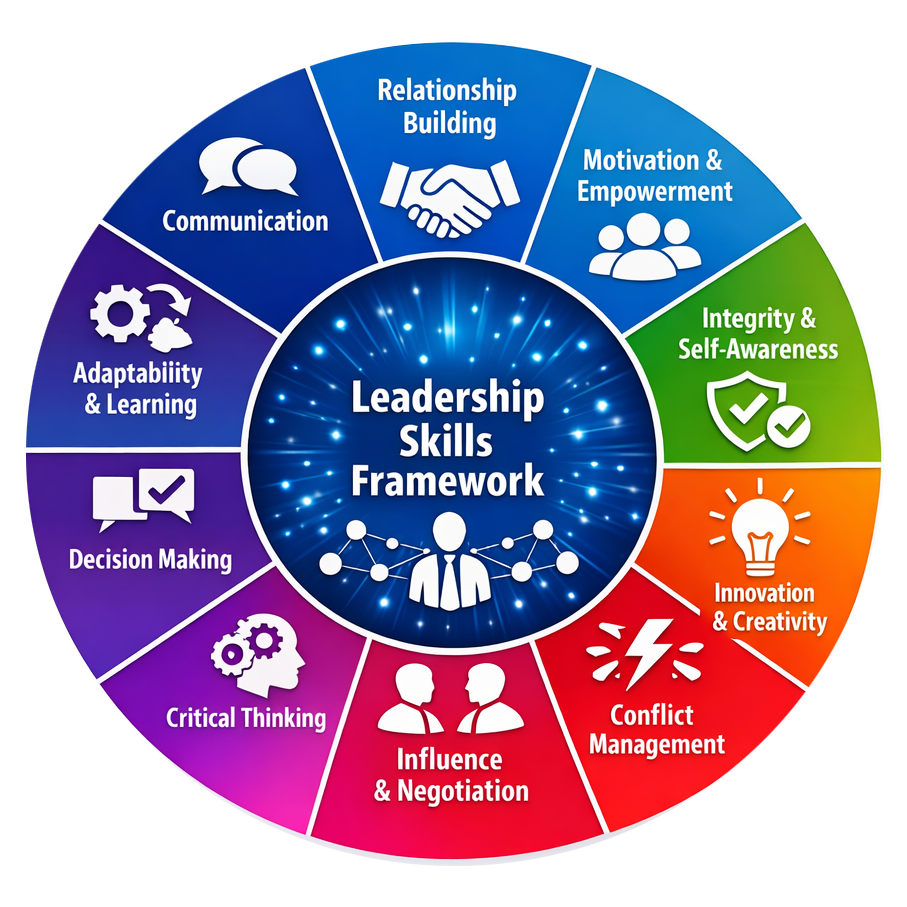
The diagram on the right provides an overview of the leadership skills framework. It shows how these capabilities connect and reinforce one another rather than operating as separate “standalone” skills.
| Leadership skill | What it looks like | Primary outcome |
| Relationship building & collaboration | Build trust, psychological safety, open communication | Performance and resilience |
| Communication | Clear goals, listening, feedback, adapt to audience | Alignment and fewer misunderstandings |
| Adaptability & learning agility | Adjust quickly, keep learning under change | Stability and competitiveness |
| Decision-making | Decide with constraints, update with evidence | Speed and momentum |
| Critical thinking & problem-solving | Test assumptions, connect ideas, weigh trade-offs | Better solutions |
| Conflict management | Address conflict early, reduce escalation | Healthier relationships and focus |
| Motivation & empowerment | Recognise contributions, delegate, grant authority | Ownership and stronger performance |
| Innovation & creativity | Encourage ideation, protect creative space | Better processes and competitiveness |
| Integrity, accountability & self-awareness | Be consistent, own outcomes, understand impact | Trust and credibility |
| Influence & negotiation | Persuade ethically, negotiate win-win | Commitment and durable agreements |
A Practical Way to Build these Skills: Developing “Leader-Coaches”
For leadership programs to work, managers must be able to apply skills immediately—in performance conversations, team dynamics, stakeholder management, and change leadership.
 That’s why a coach-based approach is so effective. Because, coaching capabilities strengthen communication, motivation, decision quality, conflict handling, and relationship building through one repeatable set of behaviours.
The Certified Performance Leadership Coach (CPLC) program is designed for leaders, HR practitioners, and professionals. The goal is to equip learners with core coaching competencies to coach at individual and team levels. So as to enhance performance and achieve organisational goals.
 The Certified Self-Mastery Coach (CSMC) program builds on that foundation with advanced coaching principles and Positive Psychology competencies. Specifically, building self-mastery skills such as mastering emotions, attention, thoughts, motivation, and actions to achieve goals.
For organisations, this matters because it moves leadership development from “knowledge” to “behaviour change”. It’s the difference between a session that feels useful in the moment and a program that actually changes how managers run performance conversations, day to day.
Where Modules 1–6 Build the Leadership Competencies (a Simple HR Map)
If you’re planning a structured leadership pathway, here’s an easy mapping for how Modules 1–6 can cover the leadership competencies above (Modules 1–4 from CPLC, plus two advanced classroom modules from CSMC).
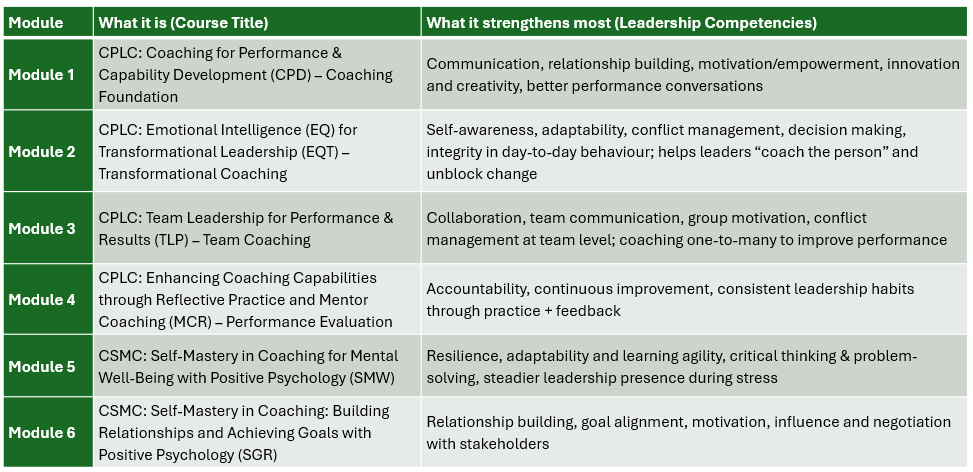
Mapping of Leadership Competencies for Module 1-6
SkillsFuture (SSG) Funding: Enabling Scale (not just “High Potentials”)
 Obviously budget is a real constraint, especially when you want to develop not only senior leaders but also the full layer of people managers. So, how can one lower these training cost?
Singapore Citizens (SC) and Singapore Permanent Residents (SPR) may be eligible for an SSG Training Grant subsidy of up to 70% under the WSQ Employer funding scheme. This makes the leadership roadmap easier to scale across the organisation. In short, leadership development becomes an ongoing capability-building system, not a once-a-year event.
Summary: A Leadership Program that Addresses Top Leadership Skills
If you want managers who can communicate clearly, build trust, handle conflict, and make good decisions, train them for daily behaviour change. Not just knowledge. They should also learn to motivate people and lead through change.
That’s why these leadership skills keep appearing among the top priorities. A structured coach-based pathway like CPLC + CSMC (supported by SkillsFuture funding eligibility) is a practical option for many organisation leaders, and HR teams planning leadership development for managers.
*Sources:
- IMD — The 8 Key Leadership Skills You Need to Know in 2025
- SMU Academy — 12 Essential Leadership Qualities That Define Strong & Effective Leaders
- Center for Creative Leadership (CCL) — The 12 Characteristics of a Good Leader
- FranklinCovey — 12 Essential Leadership Skills to Develop: Your Guide to Becoming an Effective Leader
For more details, visit BP Coach Training or contact us at info@bpcoachtrain.com.
Check out our Client Testimonials and Google Reviews for our program.
BP Coach Training Pte Ltd
20 February 2026