



Did you know ICF offers 3 levels of credentialing? And there are 3 pathways to acquire your credentials? Sounds confusing? You are not alone. We do get a lot of questions from aspiring coaches asking about the differences. Let’s demystify this once and for all…
ICF Credentials
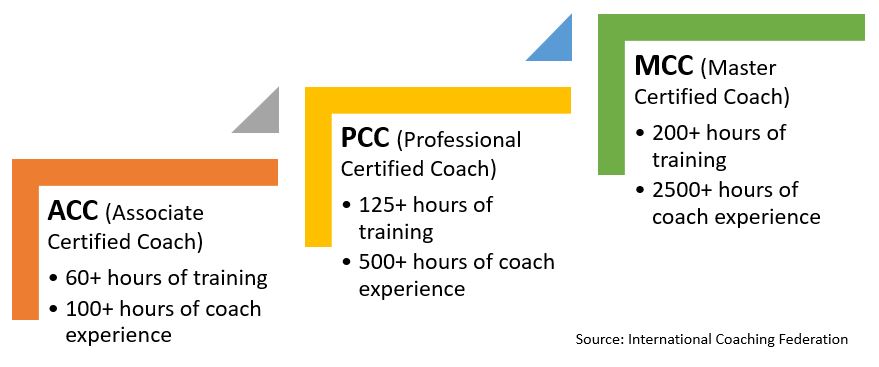
International Coaching Federation, ICF offers three levels of credentials:
- ACC (Associate Certified Coach)
- PCC (Professional Certified Coach) and
- MCC (Master Certified Coach).
Like any other credentialing bodies, there are training and practical skills experience requirements for one to qualify for each of the credential. The main differences between the three levels of credentials are shown below.
ICF Pathways
Everyone of us have our own learning preferences. As such, ICF offers different pathways for potential applicant to choose from. The ICF pathways are: (please see updated ICF credentialing updates wef. 1 January 2027).
- ICF Level 1 (for ACC credential) Path
- ICF Level 2 (for ACC/PCC credential) Path
- Portfolio (through Continuing Coach Education CCE) Path

ICF ACC Credential Requirements
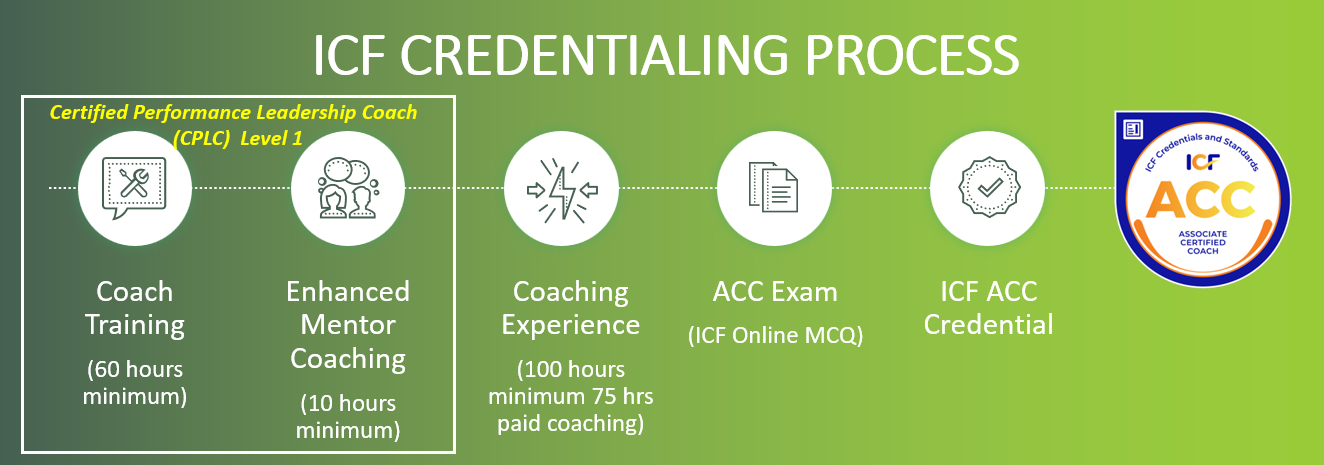
Before we go into the details of what each path entails, let’s take a look at the requirements for the first level of ICF ACC credential. Essentially, every applicant has to complete the following to receive his or her ACC credential.
- Complete a minimum of 60 hours of coach-specific training
- Complete 10 hours of Enhanced Mentor Coaching**
- Clocked 100 coaching hours (75 hours must be paid-coaching, 25 hours can be pro-bono coaching) – no time limit
- Complete an online ACC Exam (MCQ), administered by ICF Global
- Receive ICF ACC credential upon successful completion
** ICF is retiring Performance Evaluation in 2027 and replacing with Enhanced Mentor Coaching.
Which credentialing path should one take?
Training providers may offer a variety of programs that are accredited by ICF. Some training providers may only offer one path e.g. Level 2 path. In this case, if you choose that training provider, you will only follow that Level 2 path. Others may offer multiple options. In other words, the training program that you choose determines your pathway. However, many aspiring coaches may not realise this upfront.
Of course, everyone of us has different criteria when it comes to choosing the training provider. This might range from cost, training grants subsidy, quality, program structure, flexibility, facilitator’s experience, recommendations etc. The pathway is usually not one of the criteria being considered unless you are aware of it upfront.
Let’s take a look at the different pathways for the ACC credential.
Level 2 Path
The Level 2 program is targeted for those pursuing the ICF PCC credential. It consists of:
- Minimum of 125 hours of coach-specific training
- 10 hours of mentor coaching
But wait – why would someone want to pay extra and spend a minimum of 125 hour of coach-specific training when you only need 60 hours for ACC credential? Well, I guess if you have already decided you want to pursue all the way to PCC credential, then it’s ok. That’s what the Level 2 program is structured for. Some Level 2 training providers do offer you the option to complete halfway.
If you are only pursuing the ICF ACC credential, please confirm that the training provider allows you to complete just the required 60 hours of coach-specific training if you choose not to enrol in the full programme. You should also check whether they can issue a Level 1 certificate upon completion.
Level 1 Path
If your goal is simply to pursue the ICF ACC credential, the Level 1 pathway would be a suitable option. A Level 1 programme covers all the core coaching competencies required by the ICF while also offering greater flexibility. Some training providers may also offer a modular format, allowing participants to explore whether coaching is the right fit for them before committing to the full programme.
The Level 1 programme consists of:
- Minimum 60 hours of coach-specific training
- 10 hours of mentor coaching (optional depending on training providers)
The advantage of the Level 1 program is that the training provider would have packaged all the ICF coaching competencies required for credentialing. Unlike the Portfolio path (which we will cover next), the applicant does not need to worry if the courses that he has taken covers all the mandatory competencies. Moreover, there is only one certificate that needs to be submitted during the application.
Applicants have the option to find their own mentor coach if the training provider does not include mentor coaching as part of the Level 1 program. In short, the Level 1 program would cover Steps 1 & 2 of the credentialing process. Applicants will have the flexibility and time to complete the rest of the process on their own.
Portfolio Path
Finally, aspiring coaches who prefer to take modular courses from one or more training providers can choose the Portfolio path. These modular courses may consist of programs approved by ICF under the Continuing Coach Education (CCE) program or from non-approved ICF coach training.
- Minimum of 60 hours of coach-specific training from multiple courses.
- Need to demonstrate the accumulated courses cover all the ICF coaching competencies required for credentialing.
The Portfolio path offers lots of flexibility for learners to acquire the coaching skills over time from different training providers. They are not restricted to the program schedule mandated by most Level 1 or Level 2 training providers. They would also have the flexibility of choosing their own mentor coaches as well.
On the other hand, applicants need to submit multiple certificates during application. For each module, they would have to indicate which ICF coaching competencies are covered. This might pose a challenge for new coaches who may not be well-versed with the ICF coaching competencies, unless they seek the help of the training providers. In short, while Portfolio path offers the greatest flexibility, the application process is more cumbersome. Ultimately, Portfolio path covers only Step 1 of the credentialing process.
* For participants who were under the old ACSTH path, application for the ACC credential would be under this Portfolio pathway.
Conclusion
We hope that this has helped you to demystify the difference between ICF credentials and the different ICF pathways.
To learn more about our Coach Certification Program (Level 1) , Level 2 or CCE (Portfolio) courses, please contact us for more details.
Written by Laurence Tan (Leadership Coach/Trainer and Author)
Director, BP Coach Training Pte Ltd
First Written: